





Bagmaking Tools
install your bag hardware
There are various tools you can use to install bag hardware. Some tools use hand strength and others are easier to use. It’s important to know the options, as well as how and when to use them.
For example, you use tools to install rivets or grommets onto a bag. First you use a hole puncher, then you use a tool designed to apply enough force that the rivet or grommet will not come loose.
Tools vary in terms of ease of use and price.
FAQ
When you look to buy a tool for bagmaking, you need to determine your budget first. You also need to decide between using your own strength, like with a hammer, or using assisted force, like with a table press. The hardware you want to install will also dictate whether the size or shape of the tool is important.
The simplest and least expensive tools involve more manual dexterity and strength. They also tend to have a longer installation time.
To get through more projects more quickly, you want to invest in better tools that create a more automated process.
For example, you can install rivets using a hand tool like the Prym Vario Pliers, fitted with the correct set of dies for your hardware. You will need to manually adjust the placement of where you want to make the hole or apply the rivet. Then you need to have the hand strength to use the pliers.
Alternatively, you can install rivets using a table press like the one from Kam, also fitted with the correct set of dies for your hardware. The table press is more expensive, but requires little hand strength. It also allows you to place your project in a fixed spot where the hole will be made or the rivet installed. The end results will be more precise.
If you are only installing a few rivets a year, the manual pliers might make sense. But for repeated projects, you can decide whether a little investment is worth the time savings and added precision.

Common Bagmaking Tools


Many tools are available for bagmakers.
Select one of the following for magnetic snap installation steps using a table press or Prym Vario pliers.

Step 1
Line up the magnet halves and mark the placement for the rivet holes, then carefully punch the holes using a table press fitted with a hole puncher on the top and an anvil on the bottom.
The male magnet half (with a protrusion) goes on the underside of a flap. The female half (with a depression) goes on the main part of the bag.

Step 2
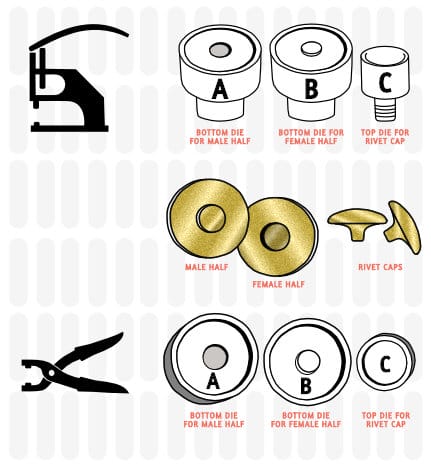
Gather the dies for the table press.
There is one die for the rivet caps (C), one die for the male magnet half (A; this has a depression), and one die for the female magnet half (B; this has a protrusion).

Step 3
Attach the dies to the table press. The rivet cap die (C) goes on the top. The magnet die (A) goes on the bottom.
We will be installing the male magnet half first.

Step 4
Place the rivet cap through the punched hole (A) so that it is visible on the exterior of the flap. Place the male magnet half through the same hole from the other side, and lightly click the pieces together. The male magnet half should be on the underside of the flap.

Step 5
Position the male magnet half face down into the die (A) and the rivet cap into die (C). Install by pushing down on the long handle of the table press. It should not take much force.

Step 6
We will be installing the female magnet half next.
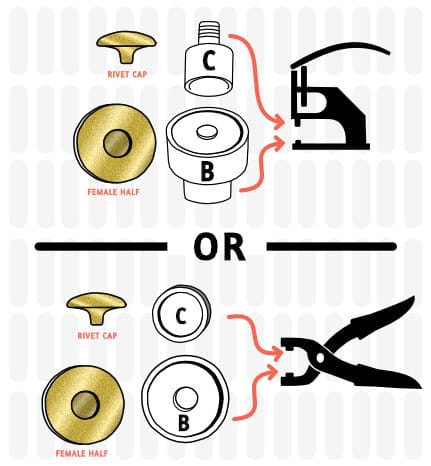
Leave the rivet cap die (C) on the top. The magnet die (B) goes on the bottom.

Step 7
Place the rivet cap through the punched hole (B) so that it is visible on the interior of the bag. Place the female magnet half through the same hole from the other side, and lightly click the pieces together. The female magnet half should be on the exterior of the bag.
Step 8
Position the female magnet half face down into the die (B) and the rivet cap into die (C). Install by pressing down on the handle of the table press. It should not take much force.

Step 9
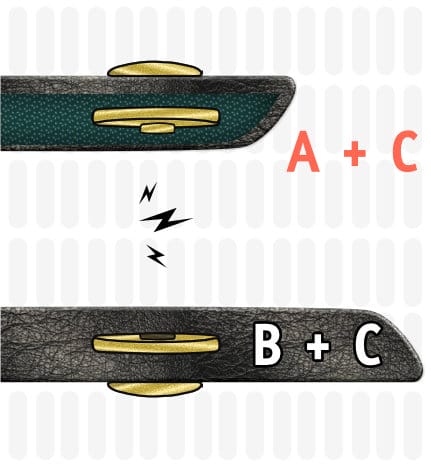
The magnet is installed!

Step 1
Line up the magnet halves and mark the placement for the rivet holes, then carefully punch the holes with a manual hole puncher or Prym Vario pliers fitted with hole punch dies.
The male magnet half (with a protrusion) goes on the underside of a flap. The female half (with a depression) goes on the main part of the bag.

Step 2
Gather the dies for the Prym Vario pliers.
There is one die for the rivet caps (C), one die for the male magnet half (A; this has a depression), and one die for the female magnet half (B; this has a protrusion).

Step 3
Attach the dies to Prym Vario pliers. The rivet cap die (C) goes on the top. The magnet die (A) goes on the bottom.
We will be installing the male magnet half first.

Step 4
Place the rivet cap through the punched hole (A) so that it is visible on the exterior of the flap. Place the male magnet half through the same hole from the other side, and lightly click the pieces together. The male magnet half should be on the underside of the flap.
Position the male magnet half face down into the die (A) and the rivet cap into die (C). Install by firmly squeezing the Prym Vario pliers closed.

Step 5
We will be installing the female magnet half next.
Leave the rivet cap die (C) on the top. The magnet die (B) goes on the bottom.

Step 6
Place the rivet cap through the punched hole (B) so that it is visible on the interior of the bag. Place the female magnet half through the same hole from the other side, and lightly click the pieces together. The female magnet half should be on the exterior of the bag.
Position the female magnet half face down into the die (B) and the rivet cap into die (C). Install using your tool by firmly squeezing the Prym Vario pliers closed.
Step 7
The magnet is installed!


